
Discovered in the early 1800’s, chlorine revolutionized many industrial processes — from sterilizing potable water to sanitizing swimming pools. But too much of a good thing can be, to put it simply, bad.
Too Much Chlorine
You may not realize you’re using too much chlorine in your pool until:
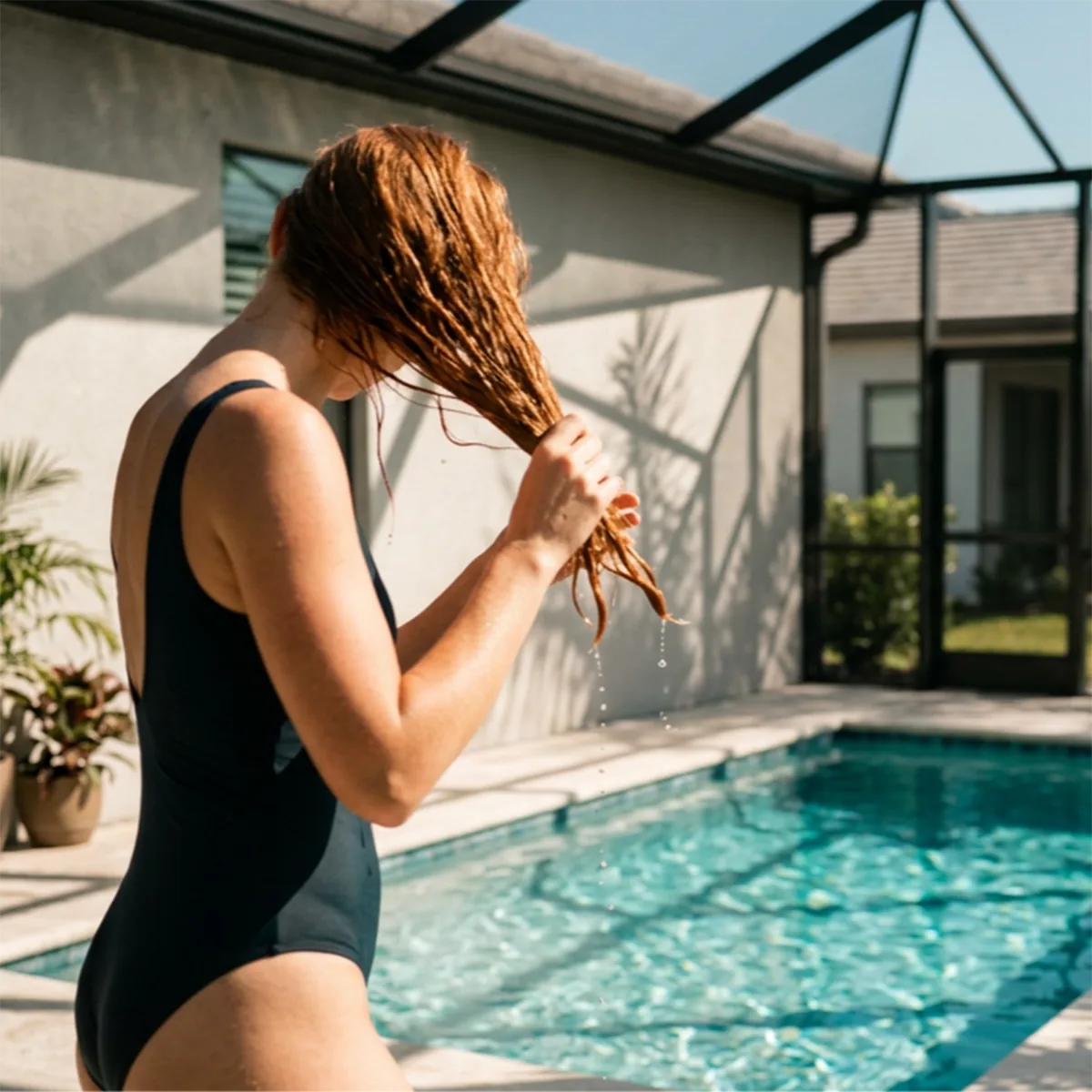
- You notice swimsuits bleach out quickly
- Swimmers complain about itchy skin
- People in your pool have red eyes
- Someone says, “I love that chlorine smell!”
Worse, your pool surfaces may become faded or pitted. While you may think that’s to be expected, that’s not true and you can avoid that.
Maintaining the right chlorine level can be tricky. Plus, most pool owners don’t realize the huge downside of using too much or too little chlorine before problems start.
It may seem obvious, but testing your pool water regularly is always the best practice. That way you’ll know what your chlorine levels are and can make adjustments before the water becomes a problem.
Here are a few tips if you are over-chlorinating:
Tip #1: Check Your Dial Setting
If you use a chlorinator or salt generator turn the dial down.
If your pool water is greatly over-chlorinated, turn the device off until the level comes down to your desired number (between 1.0 and 3.0 ppm typically).
To help find the correct setting that will maintain that chlorine level, adjust only one setting per day, and test the water after 24 hours to see the effect.
Once you find the correct setting do not alter it. When abnormal conditions arise (pool party or a lot of rain) that’s the time to shock the water.
Tip #2: Cut Back on Chlorine
If you use a chlorinator or floater, the setting may not be enough to regulate the output properly. You may need to resort to filling the unit partially full.
Since these units often wet all the chlorine at once, it is difficult to regulate with exactness.
The more chlorine that is wetted, the greater the output. If you’re putting chlorine pucks in the skimmer by hand or using liquid, cut back on the amount you add or the frequency.
Tip #3: Make Sure Your Water is Properly Balanced
Water balance is critical to proper sanitization.
However, if the pH is higher or lower than 7.2-7.8, that could cause chlorine to become ineffective.
In a pool where the pH level is below 7.2 chlorine dissipates much more quickly, which translates into a larger chemical expense and more time spent adding sanitizers to your pool.
On the other hand, if the pH level is higher than 7.8, chlorine loses its ability to sanitize the water, forcing you to use more chlorine to achieve the same chlorine concentration as a pool with a balanced pH level.
For example, at a pH of 8.2, chlorine concentration can only reach 15%. This means that if you only had to add one dose of chlorine at a pH of 7.2, at a pH of 8.2 you would need to add 5x that amount to achieve the same chlorine concentration.
Keep pH within the ideal 7.2 – 7.8, it can save you from troubleshooting!
Tip #4: Look at Your Pool Usage
If the pool isn’t used very often, then the need for chlorine is lessened.
If this is a temporary situation, such as during the spring when temperatures are cooler, cut back on the amount of chemicals you’re dispensing until your normal use pattern returns.
Tip #5: Shorten Your Pump Run Time
Very few pools are used enough to require a 24 hour circulation, yet many pools run their pump that long.
Any inline feeding device continues to dispense chlorine every minute the circulation is running. To cut back on how much is dispensed, consider adding a timer to your pool and cutting the circulation time.
Tip #6: Check the Expiration Date
Most test strips and testing reagents last only 12 to 18 months. Look for the date stamp on your test strip bottle or kit. After that date, they may not register readings properly.
Dry your fingers and hands before grabbing a test strip. Wet fingers or hands that reach into the test strip container can easily contaminate the strips, which will shorten their life even further.
Tip #7: Let the Sun Shine In!
Another way to reduce chlorine: remove the pool cover and leave it off for a while; sunlight’s UV rays burn off chlorine and can thus lower chlorine levels in relatively short periods of time.
Use a test strip or test kit to test frequently so all your chlorine doesn’t dissipate before you realize it.
Tip #8: Drain and Refill
If time isn’t an issue, drain and refill some of the pool water to reduce chlorine in the pool.
However, this process may have an impact on your pool’s chemical balance, so you’ll need to test and rebalance your pool water to ensure it’s within ideal parameters:
Alcalinidad total: 80 – 120 ppm
pH: 7.2 – 7.8
Total Hardness (also known as Calcium Hardness): 200 – 400 ppm
Having trouble maintaining consistent chlorine levels?
Consider upgrading your sanitizing system.
If you’re relying on traditional chlorine alone, there’s a better way to enjoy your pool.
With Piscina FROG®, you can experience Fresh Mineral Water®∞ — our signature water quality made possible by combining patented, EPA-registered FROG Sanitizing Minerals® with a low level of chlorine. The result is water that’s Cleaner, Clearer and Softer® while using up to 50% less chlorine* than traditional chlorine pools.
Because FROG Sanitizing Minerals® work alongside chlorine to fight bacteria, Piscina FROG maintains an ideal chlorine level of just 0.5–1.0 ppm instead of the 2.0–4.0 ppm many pool owners target with traditional chlorine systems. That means you get the protection you need without relying on high chlorine levels.
The difference isn’t just something you’ll measure — it’s something you’ll notice every time you swim:
- Softer-feeling water that’s gentler on skin and hair
- Less chlorine odor and none of the harsh over-chlorinated feel
- Swimsuits that stay brighter longer
- Better protection for pool surfaces and equipment
- Cleaner, clearer water that’s easier to maintain
If you’re ready to spend less time managing your water and more time enjoying it, Piscina FROG® delivers a Fresh Mineral Water experience that traditional chlorine simply can’t match.
Sources:
1. Michele Hlavsa, chief of the Centers for Diseases Control and Prevention’s Healthy Swimming Program
* En comparación con el nivel mínimo de cloro recomendado por la EPA de 1,0 ppm para una piscina estabilizada.
∞ Agua más limpia, cristalina y suave para piscinas, jacuzzis y spas de natación.